Heading 2
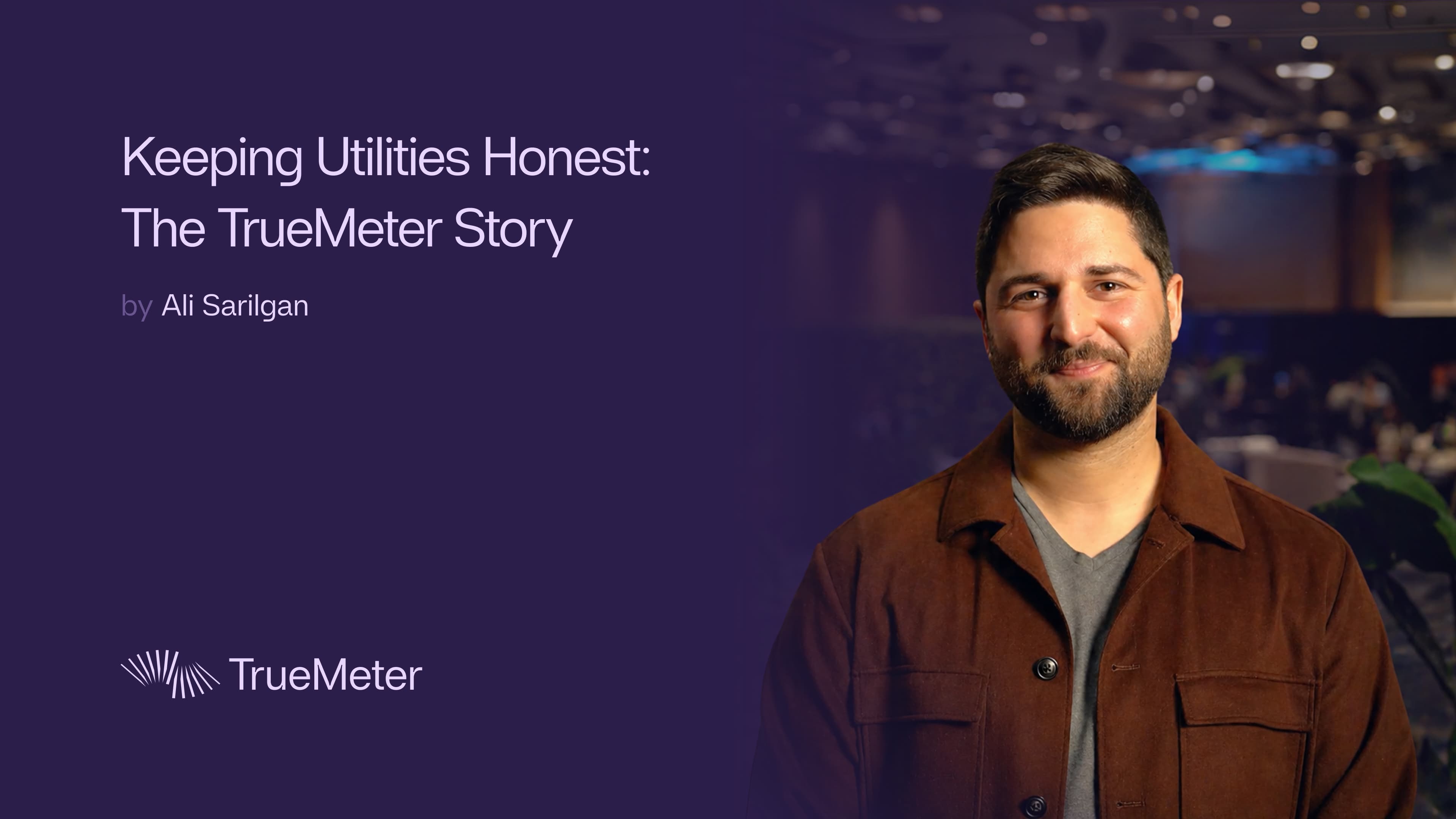
Keeping Utilities Honest: The TrueMeter Story
I've lived and worked in many different cities and countries throughout my life. Across all of them, I've yet to find one where utilities worked properly, charged fairly, and didn't spark controversy. The frustrations seemed universal: confusion over electricity bills that don't make sense, costs that surge without explanation, and that nagging feeling you're being overcharged.
Jul 14, 2026
7 min
Index
I've lived and worked in many different cities and countries throughout my life. Across all of them, I've yet to find one where utilities worked properly, charged fairly, and didn't spark controversy. The frustrations seemed universal: confusion over electricity bills that don't make sense, costs that surge without explanation, and that nagging feeling you're being overcharged.
I wanted to know why the system was so broken.
After focusing on energy and engineering at Stanford, I got my answer. It was 2019, and I'd landed a job working with companies in technology, energy, and climate, including utilities. That role gave me a front-row seat to how energy markets are structured, and how rarely that structure works in the customer's favor. Worst of all, in that role there was nothing I could do about it.
When I shifted from consulting to corporate finance, I thought I'd finally be able to take advantage of everything I'd learned about the dark side of utilities. I was wrong.
There I was, leading corporate finance and strategy at GameStop during one of the most volatile periods in the company's history. I'd gone from advising from the sidelines to being responsible for outcomes. My responsibilities were staggering in scope: forecasting and managing utility spend across 4,500 locations worldwide.
We had so much on our side: significant resources, a sophisticated finance team, and the operational scale of a major retailer. And still, we failed at forecasting our utility spend. I had a hard-working, brilliant team, and the task at hand was effectively impossible with the tools that existed at the time.
We were no match for rates that change by location, varied tariff structures, deregulated markets that exist alongside monopolies, and contracts that expire silently and transfer to suboptimal terms. Especially not with all of it documented in thousands of pages of dense regulatory text that even seasoned energy professionals struggle to parse.
It hit me just how much businesses actually spend on power and just how little visibility and control they have over it. For a multi-location chain like ours, it represented millions of dollars of blind spots every year.
I knew the system itself needed to change, but I didn't see a clear path forward. Then ChatGPT arrived.
Around the same time, I was introduced to Dr. Ozge Islegen-Wojdyla, a Stanford PhD graduate who had taken a very different, but surprisingly complementary, path. She spent nearly two decades researching energy supply chains and pricing. Her work spanned carbon policy, utility technology transitions, solar manufacturing economics, and the dynamics of regulated versus deregulated energy markets.
After her PhD, she joined the Stanford faculty as a professor, teaching energy markets and pricing to doctoral students. Then, like me, she felt called to apply her insights in the real world. She joined Instacart as a data scientist and led pricing experiments during hypergrowth at the start of the pandemic. She learned what it looked like to apply rigorous analytical thinking to a real-time, high-stakes data environment at scale, and how quickly applied insight could create impact compared to the years-long publication cycles of academic research.
Here was someone who'd spent her career understanding the structural complexity of energy markets. Someone who could see what I couldn't. We realized we had something powerful together: deep energy market expertise combined with enterprise operational experience. And we knew it was the kind of foundation that might actually solve this problem.
Still, our core insight felt radical for two people who'd struggled with this for so long.
What if AI could do what humans couldn't? What if we could build an AI-powered utility agent that automatically audits utility bills, understands rate structures across thousands of tariffs and market contexts, finds the optimal rates for customers, and manages all the compliance work?
It sounds straightforward now that we've proved it's possible, but at the time, it felt like heresy. The energy industry operates on information asymmetry, and utilities benefit from the complexity. Everyone accepts that utility bills are opaque and expensive, so challenging that meant we were trying to change an industry most people thought was immovable.
We were told no hundreds of times, if not thousands. Investors questioned whether AI was ready for something so complex. Industry experts wondered if we truly understood the regulatory landscape. Customers hesitated since they'd already accepted overpaying for utilities as the cost of doing business.
But we were persistent. We listened to the feedback, revised our pitch, and even changed our company name to better reflect our vision. Gradually, others started to believe it was possible, too.
Today, we've delivered over $10 million in verified savings for our customers across restaurants, retail chains, and hospitality brands through our platform that tracks, pays, and lowers utility bills for multi-location chains. We make it all possible without requiring an energy team, upfront investment, or operational changes.
We're managing bills for our customers, but equally important for Ozge and me, we're keeping utilities honest. Because TrueMeter doesn't just process utility bills the way a bill-pay vendor does. It understands the regulatory and market context behind them.
For a restaurant chain with 50 locations, that can mean millions of dollars recovered. It also means long-missing visibility, control, and trust. For the first time, businesses know they're getting the best rate available in their market because they can see exactly what they're paying and why.
We're not here to manage your utility bills. We're here to prove that the way you've always paid for power doesn't have to be the way you pay forever.
Share article
Ready to see what your current vendor is missing?
Book a free audit. No cost, no commitment, and no disruption to your current setup. We'll show you exactly what's in your bills.
Resources
Learn more about energy savings
Stay up to date with our latest publications.
Why Operators Prefer TrueMeter Over Schneider Electric
Schneider Electric is a utility bill payment service owned by Schneider Electric SE, a French multinational corporation that has offerings in physical generation assets, energy technology, and digitalization for industry. Their bill pay platform processes utility bills for multi-location businesses at $3-17 per bill with no savings optimization. This per-bill model creates a structural misalignment. Schneider Electric is paid the same amount whether or not your bill is accurate or optimized.
CFOs
Engineers
Operators
30 Apr 2026
|
5 min
Why Operators Prefer TrueMeter Over Engie Impact
Most utility bill management providers focus on one outcome: getting invoices paid on time. Engie Impact fits that mold. Their service centers on collecting bills, running tolerance checks, and presenting consolidated invoices for funding, while clients pay on a per-invoice basis with no direct link between fees and the savings produced.
Engineers
Operators
CFOs
30 Apr 2026
|
5 min
Keeping Utilities Honest: The TrueMeter Story
I've lived and worked in many different cities and countries throughout my life. Across all of them, I've yet to find one where utilities worked properly, charged fairly, and didn't spark controversy. The frustrations seemed universal: confusion over electricity bills that don't make sense, costs that surge without explanation, and that nagging feeling you're being overcharged.
CFOs
Engineers
Operators
30 Apr 2026
|
7 min